Dark Wood
The Amazing Maurice and His Educated RodentsThe Dark Wood is first introduced as a threatening place in Mr Bunnsy Has An Adventure, but its importance grows when Darktan applies the story’s name to the tunnels the rats must enter. It is at once a place of danger, a figure for fear, and a language the rats can use to imagine themselves as brave. By the time Darktan says the Dark Wood has been found in their hearts, the setting has become an inward condition as well as an underground one.
A danger first encountered in a story
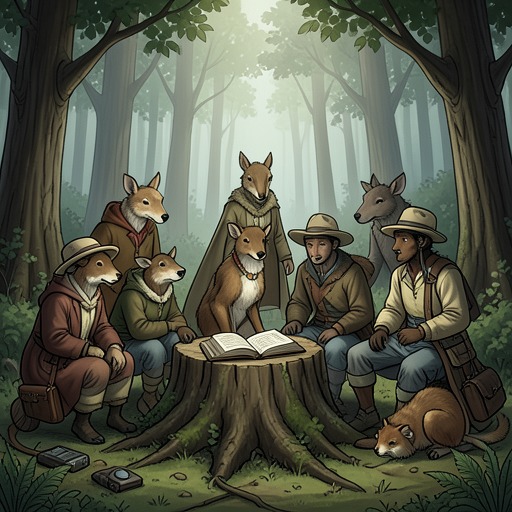
In Mr Bunnsy Has An Adventure, the Dark Wood appears in a sentence remembered as night falls: something terrible is there. The warning does not identify the threat or explain what makes the place dangerous. Instead, it gives the forest the shape of an approaching fear: a named location whose danger remains unseen. That withholding matters when Darktan later borrows the image. He does not introduce a detailed map or a new account of the forest; he takes the simple promise of terror from a familiar story and makes it serve the rats’ immediate situation.
The phrase also bridges two kinds of storytelling. In the book, the Dark Wood belongs to Mr Bunnsy’s adventure; in the tunnels, it becomes a way of interpreting danger the rats must actually face. The transfer does not make the tunnels safe or prove that the book’s threat is literally present there. Rather, Darktan uses the story’s terms to give the rats a frame for what they cannot yet see. What begins as a warning about something terrible becomes a challenge to go looking for it.
Darktan gives the tunnels a name
As the rats prepare to move through the tunnels, Darktan first falters over what to tell them. He catches sight of Sardines shaking his head, recognizes that a leader cannot simply announce uncertainty, and begins again. His solution is to describe the rats themselves as something new: thinking creatures who do not have to turn and run from darkness, fire, noises, traps, or poisons. Then he connects their situation to the story: they are in the Dark Wood, and something terrible is hiding behind their fear.
The name changes the emphasis of the threat. Darktan does not promise that the danger is imaginary; he says that it thinks it can stop them and that they will find it and drag it out. The forest becomes a test of the rats’ resolve, while the act of entering it becomes evidence of what they can do together. His allusion to the Bone Rat sharpens that challenge: it waits for those who break and run, hide, or falter, but will nod and pass on if faced directly. The story thus supplies both a danger and a rule for meeting it.
Darktan’s speech also makes the name communal. As he speaks, he sees the squad’s excitement, and the narration describes the imagined world behind their eyes, where they are the bravest rats there ever were. He understands that this confidence must be held in place, not merely stirred up for a moment. The Dark Wood gives the rats a shared account of their fear and a shared identity with which to confront it.
Blood marks and inward territory
Darktan’s appeal is tied to his body. He touches the wound across his chest, which is healing badly and still leaking blood, and recognizes that it will leave a large scar. He then walks along the row of rats, marking each one above the eyes with his own blood. The gesture makes the speech tangible: the rats’ imagined courage is joined to the visible evidence of Darktan’s injury. He predicts that afterward people will say the rats went into the Dark Wood, did what they had to do, and came back out able to recognize one another as their own.
This is not simply a promise of individual survival. Darktan speaks of a remembered ordeal that will define the group: they will know one another by having entered and returned. The Dark Wood therefore becomes a threshold in the rats’ collective story, with the blood marks anticipating a shared experience before it is complete. His cry that the wood belongs to them reverses its earlier threat. The place is not made harmless; the rats claim the right to face it together.
Later, Darktan expands the image from the tunnels to the rats themselves. He calls for them to continue until the tunnels are safe from end to end, then to do it again until the tunnels are theirs. Leaning on his sword to catch his breath, he says they are in the heart of the Dark Wood and have found it in their own hearts; for that night, they are something terrible. The movement is from a place outside them to an inner capacity for fearsome action. Yet his final admission, spoken only to the rats closest to him, is that they have nowhere else to go. The boldness of the image does not erase their constraint; it turns necessity into a source of resolve.
The light in Maurice’s tunnels
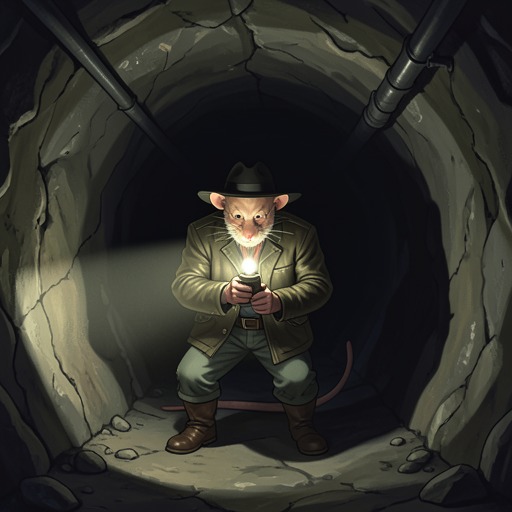
The Dark Wood also frames Maurice’s passage through the tunnels. He is squirming along a pipe and privately questions why he is doing it, observing that cats are not built for such work. Later, the smell of light reaches him. Peaches is associated with that light because she is mad about it and carries matches, even though she and the other rats live in darkness. The matches make light a portable possibility within the tunnels, rather than something the rats can take for granted.
But the direction of that light is not presented as uncomplicated rescue. Rats behind Maurice are pushing him toward it, and he suspects that he is being played with, passed from paw to paw so that Spider can hear him squeak. Spider’s voice then reaches him with a line about despair bringing him, at last, to Spider. In this passage, the underground setting is a space of pressure and manipulation as well as fear. The Dark Wood’s force lies partly in that uncertainty: its darkness may conceal a threat, but a glimmer of light can also mark a route along which someone else is steering Maurice. Across both Darktan’s address and Maurice’s movement, the image holds danger and possibility together, while making the tunnels the place where fear must be interpreted and answered.